Designing badges that mean something to a stranger
A badge-design checklist: name the claim, write assessable criteria, choose evidence and expiry, and test the credential outside your issuing platform.
Verify Open Badge · Jul 18, 2026 · 8 min read
Imagine a hiring manager opening a badge without access to your course catalogue. Can they tell what the holder actually did, and what you checked before issuing it? That is the design test. A polished icon will not rescue a vague claim.
Start with a claim you can defend
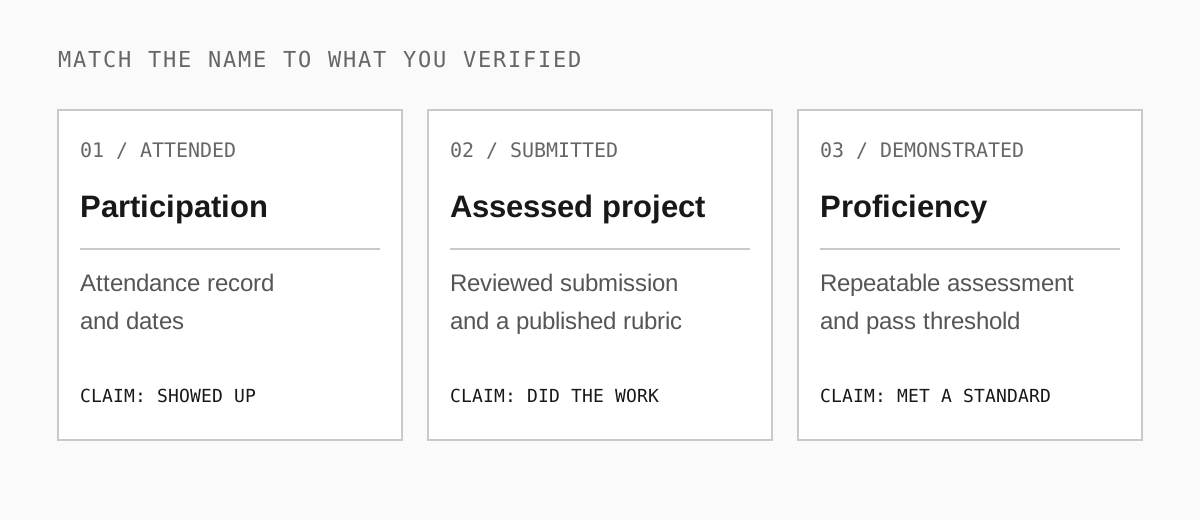
Pick the kind of recognition before naming the badge. Attendance, completion of assessed work, and demonstrated proficiency are different claims. All can be useful; none should masquerade as another.
Open the claim comparison at full size if you are reading on a phone.
Suppose you run a data course. Here is a useful progression:
- Participation: attended four workshops. Record the dates or minimum attendance threshold. Do not call this "certified analyst."
- Assessed project: cleaned a dataset, explained missing values, and submitted a reproducible analysis against a published rubric. This is a claim about work, not seat time.
- Proficiency: completed an independently reviewed assessment with a pass threshold and a defined scope. State what the assessment covered and who reviewed it.
If nobody could fail the activity, issue a participation badge and say so. A truthful small claim travels further than an impressive-sounding one that collapses under questions.
Write criteria that describe a decision
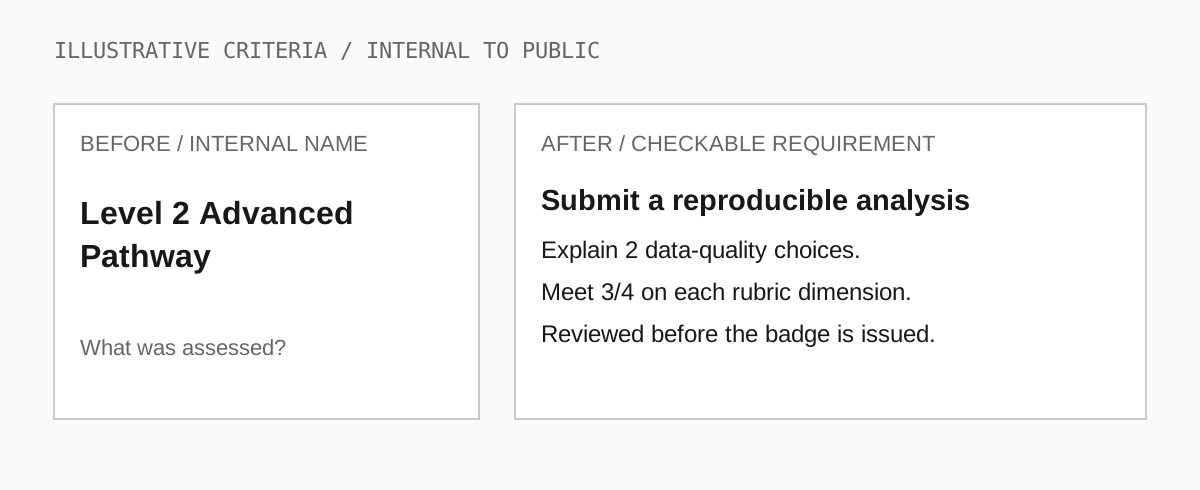
Weak criteria: "Completed the Level 2 Advanced Pathway." A reader does not know what Level 2 means, what was submitted, or what counted as success.
Better:
To earn this badge, participants clean a supplied dataset, document two data-quality decisions, and submit an analysis with a chart and a written interpretation. A reviewer scores the submission against a published four-part rubric; each criterion must reach at least 3 of 4.
Publish the rubric alongside the badge rather than promising to add one later. If the evaluation uses a score, explain the scale and the minimum. If there is a retake, say whether the badge reflects the final attempt or a demonstrated mastery threshold. Avoid declaring "40 hours of learning" if the hours are merely an estimate.
A reader should be able to answer: What did the person produce? How was it assessed? What was the threshold? If an important exception exists, such as group work, mention how individual contribution was checked.
Open the criteria example at full size.
A good test is to give the description to someone outside the programme and ask them to underline each statement they could independently verify. "Demonstrates analytical thinking" has no observable boundary. "Explains why three missing-value treatments were chosen" does. If the assessor uses a private rubric, publish at least the pass standard and the assessed dimensions. Keep internal question banks private; readers do not need the exact examination answers.
Make the assessment reproducible
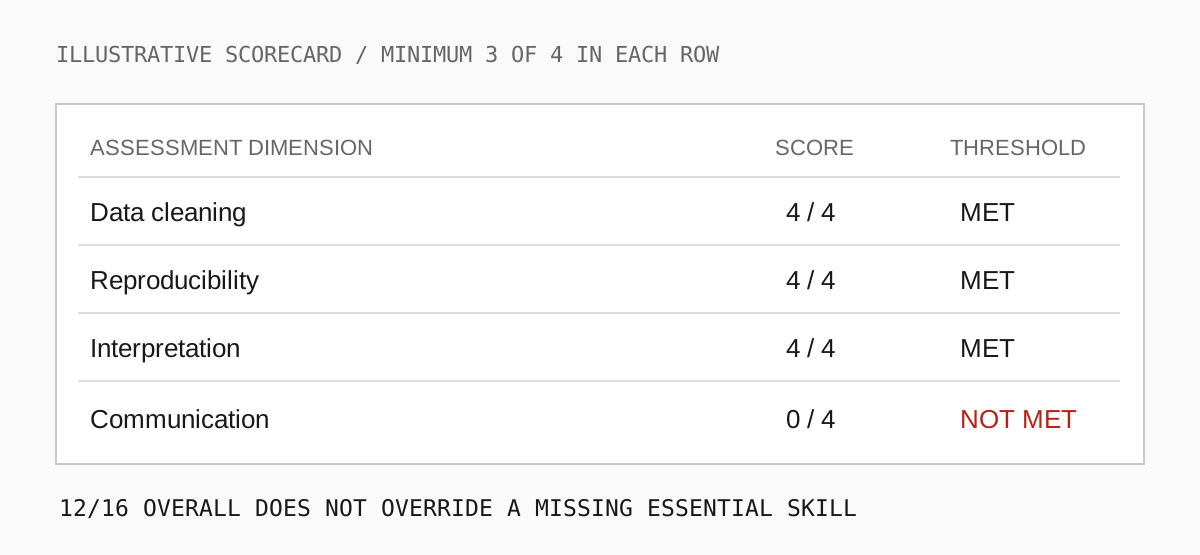
The rubric matters when more than one person awards badges. For the data project above, you might score data cleaning, reproducibility, interpretation, and communication from 0 to 4. Specify what a 3 looks like for each. "Clear interpretation" is subjective; "chart title, units, and a written account of a misleading pattern" is easier to apply consistently. Two reviewers can then discuss a score difference against the same language.
Open the example rubric at full size.
Why use a per-criterion threshold? A learner who scores 4, 4, 4, and 0 has 12 of 16 points, but has not met the fourth requirement. If that requirement is essential, the badge should not be awarded. If the assessment genuinely uses an overall score instead, state the total threshold and which tasks are compulsory. These numbers are an illustrative programme design, not an Open Badges rule.
For a group project, record the individual artefact, interview, or contribution that was checked. If the badge implies solo proficiency, a team submission alone cannot support it. Also decide what happens after a failed first attempt: can the learner resubmit, and is the same rubric used? Write this down before you have to adjudicate an appeal.
Choose a grain size people can navigate
Issue one badge per meaningful claim, not per screen the learner clicked. A year-long programme covering six unrelated topics is usually too broad; badges for every video watched are too narrow.
Try the independent-use test: would you put this badge alone on a CV and expect it to mean something? If not, combine it with related activities or leave it as progress inside your platform. A capstone badge can summarize a programme, but it should point to the separate, assessed capabilities it actually covers. Resist issuing a stack of near-identical badges for "beginner," "level one," and "bronze" unless each level has distinct criteria.
When you change an assessment materially, version the criteria. Keep a snapshot or dated rubric for past recipients. Otherwise a badge issued two years ago may appear to have been earned under today's requirements.
A practical rule: a cosmetic edit to wording can stay on the same page; a new pass score, different assessment, or newly required skill deserves a new criteria version and a dated record of which version each recipient met. For example, keep /criteria/data-analysis/2026 readable when the 2027 cohort starts. Redirects can change the address, but they must not silently replace the old requirement with the new one. Decide whether the badge name needs a year or edition only if the difference matters to a reader.
Put each detail where it helps the reader
The Open Badges 3.0 specification defines places for achievement criteria, alignment, evidence, results, and endorsements. Use the fields that express your claim; do not add data merely because the schema allows it.
Name the claim and show the pass rule
Name and description. Put the capability in the name ("Applied Data Analysis") and its scope in two plain-language sentences. An internal course code can live elsewhere. Avoid "Certified" unless it means something enforceable in your programme.
Criteria. Publish the requirements at a stable URL where possible. Link to a versioned rubric rather than a page you will overwrite next term. Archive or redirect old criteria URLs if you change platforms.
Alignment. Point to a specific skill in an external framework when it really matches the assessed work. Linking an entire framework to a 90-minute workshop makes the badge less credible, not more useful.
Share evidence without exposing learners
Evidence and results. A portfolio sample, redacted assessment, or score against a rubric can help a verifier judge the claim. Do not put private student work or personal details at a public URL by default. Ask for consent, use access-controlled evidence if needed, and test what a stranger can actually see. Evidence is optional; a broken or confidential evidence link is worse than a clear statement that the assessment was reviewed privately.
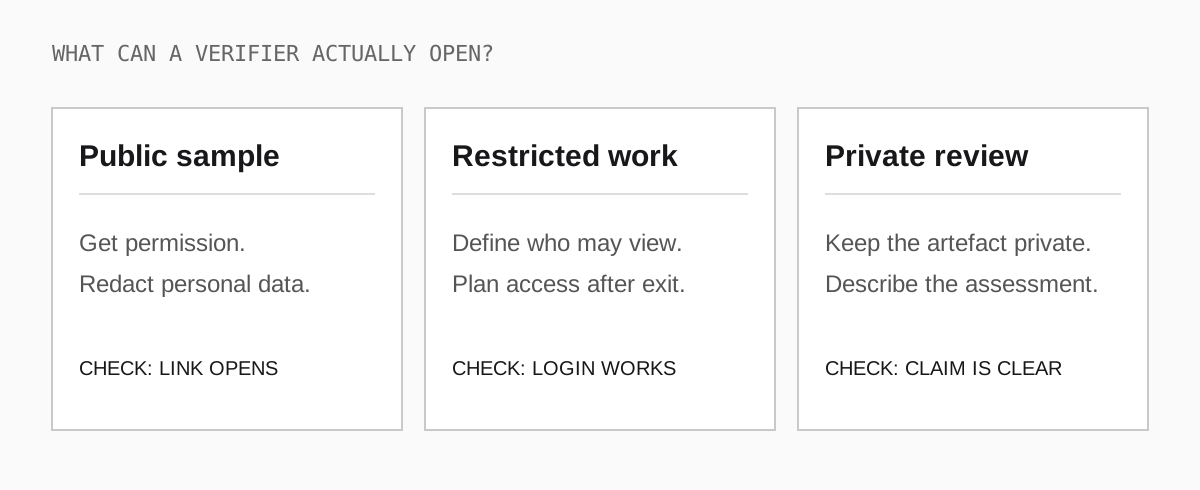
Open the evidence-access guide at full size.
For example, an employer may want to see that a nurse completed a simulation, but the underlying case materials might contain patient information. Publish the assessment method and result only if your privacy policy allows it. Never put a private URL in a signed credential and assume it stays secret: holders can share the credential itself. Test evidence links in a signed-out browser and ask what happens when a former student withdraws consent to display their work. Removing a link may make old copies less useful, but retaining private data indefinitely is worse.
Explain expiry, status and endorsement
Expiry and status. Expire badges for time-sensitive competence, such as safety procedures, if renewal is actually required. Record when the badge stops being valid. Plan how you will revoke an incorrectly issued credential, keep the status service online, and explain the difference between expiry and withdrawal to recipients.
Endorsement. A third party's endorsement can add useful context if it identifies who is endorsing what. Do not imply that an alignment link or a partner logo is an endorsement.
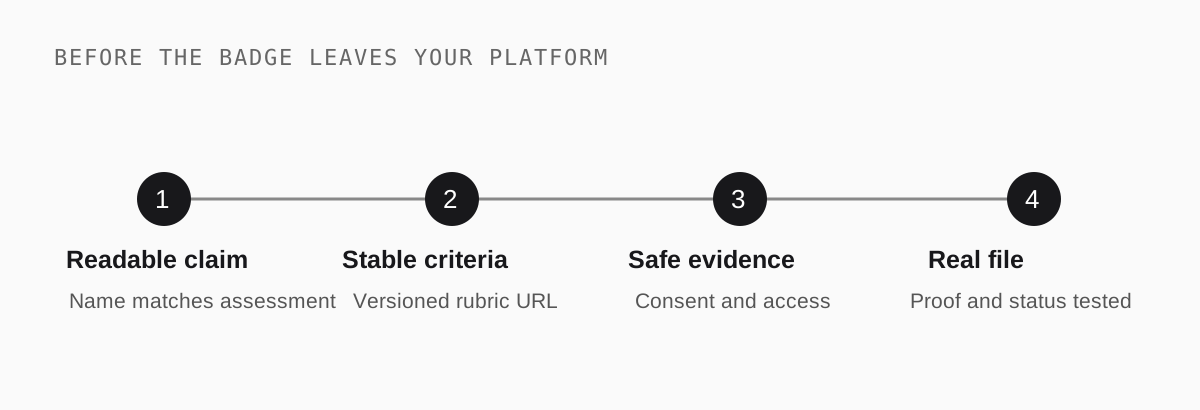
Open the handoff checklist at full size if the labels are too small on your screen.
Make the image recognizable, not authoritative
Test the icon at 64 pixels against both light and dark backgrounds. Put the level in text, not colour alone, and check that the badge name still makes sense when the icon is hidden. A copied image can look identical to an authentic one, so authenticity must come from the credential and its proof, not the artwork.
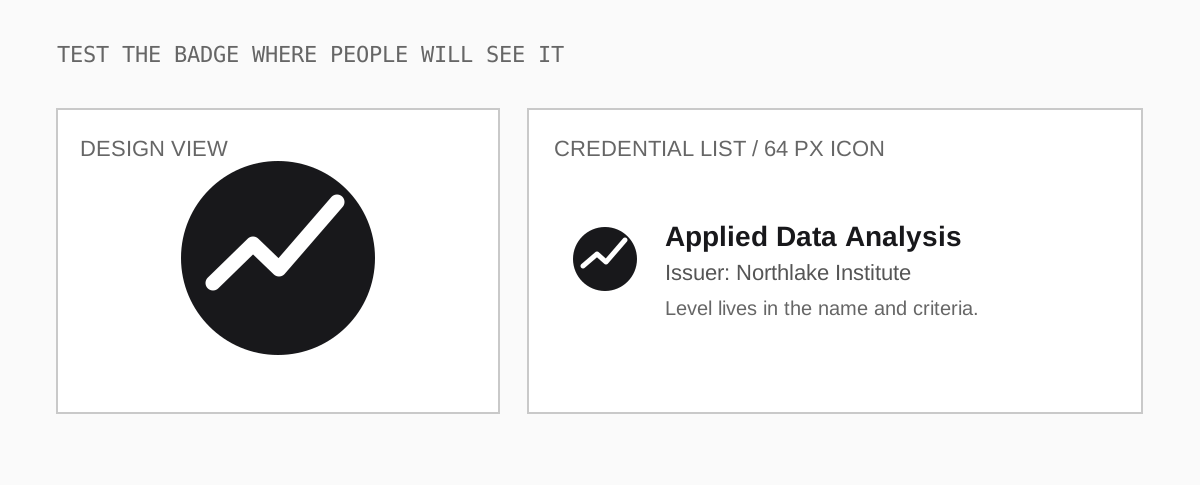
Open the thumbnail test at full size.
Do a monochrome check as well. If bronze, silver, and gold all become the same mark in grayscale, put the level in the credential name and criteria. Do not rely on fine text inside the artwork to communicate a valid-until date; dates in the credential can change how a verifier reads it, while a static image cannot. Test the design in a list alongside badges issued by other organisations, not only on a large presentation slide.
If you offer a downloadable PNG or SVG, test the actual download in a validator. An image only contains a credential if it was baked with the payload; some issuers instead deliver a separate JSON or JWT credential. A screenshot or social-media copy is just a picture. Give recipients an original file or a direct credential URL they can pass on.
Run a release test before issuing to everyone
Make a test credential for a real-looking recipient with harmless data and hand it to someone who did not build the programme. Ask what they think it claims before explaining anything. Then check:
- Can they distinguish attendance from assessed performance from the name and criteria?
- Do the rubric and any evidence links open for the intended audience, including after sign-out?
- Does the original file or credential URL validate in an independent tool? Inspect the issuer, proof, status, and any skipped checks. A skipped optional check is not evidence that it ran.
- Does a copied social image fail as expected, and do your recipient instructions tell people where to get the original?
- If you revoke the test credential, does the status change appear to a verifier? If you cannot run this test, document how you will handle mistakes after launch.
Before you issue 10,000 copies, download a few from different paths: the learner email, the wallet or platform export, and the public credential page. Check them individually. One path might hand out a baked PNG; another might produce an unbaked marketing image. Give support staff a simple response for missing_baked_payload and a link to the original credential, so recipients are not left defending a picture in an interview.
The green result tells you whether the credential is technically checkable. Your outside reader tells you whether the achievement is worth understanding. You need both. For the operational side once issuance grows, see managing a badge programme as it grows.